 Abdul
AbdulSo you’ve written your JAMB, chosen Lagos State University (LASU) as your first choice, and now you’re waiting for the next big thing — the Post-UTME screening.
Here’s the thing: LASU doesn’t play around when it comes to admissions. Every year, thousands of candidates apply, but only a few make it through. The difference? Those who understand the process and take each step seriously.
If you’re planning to join LASU in 2025, let’s talk about how the Post-UTME screening really works, what you’ll need, and the small details that make a big difference.
1. First, what exactly is LASU’s Post-UTME screening?
Think of it as the university’s way of double-checking that you actually qualify for your chosen course. It’s not just about your JAMB score — it’s about confirming your academic readiness, O’Level results, and sometimes, your ability to follow instructions properly.
Unlike some schools that conduct physical exams, LASU usually runs an online screening process. That means no physical tests, no sitting in crowded halls — just you, your credentials, and a working internet connection.
Sounds simple, right? Well, it is — but it’s also easy to mess up if you’re careless.
Read Also: Study Tips For JAMB 2026: How To Prepare Smart And Score High
2. Who’s eligible for the LASU 2025 screening?
Before you even think about applying, check if you tick all these boxes:
- You chose LASU as your first choice in the 2025 UTME.
- You scored 190 or above in JAMB (that’s the usual benchmark, though it can change slightly by year or department).
- You have at least five credit passes in your O’Level results, including English Language and Mathematics.
- You have uploaded your O’Level results on JAMB CAPS.
If you meet these, you’re good to go. But if any of those boxes are unchecked — especially the JAMB score or result upload — fix them first before you attempt the screening registration.
3. How to apply for LASU Post-UTME (step-by-step guide)
When LASU opens its screening portal, usually a few weeks after JAMB releases results, here’s what you’ll do:
Step 1: Visit the official LASU screening portal
You’ll find it at www.lasu.edu.ng. Don’t click random “LASU Screening” links from Google — too many fake portals out there. Always double-check the URL.
Step 2: Pay the screening fee
The fee is usually around ₦2,000, paid through the official portal using your debit card or generated payment invoice (via Remita). Keep your payment receipt safe — you’ll need it.
Step 3: Fill out the online form
This is where accuracy matters. You’ll enter:
- Your JAMB registration number
- O’Level results (subjects and grades)
- Personal details (name, contact info, etc.)
- Preferred course of study
You’ll also upload a passport photograph. Make sure it’s recent and clear — LASU rejects unclear images.
Step 4: Cross-check before submission
Don’t rush. Read everything twice. A single mistake — like mixing up your O’Level grades — can affect your aggregate score.
Step 5: Submit and print your screening slip
That printed slip is your evidence that you’ve completed the process. Keep it safe; you’ll need it later during admission verification.
4. How LASU calculates your admission score
Here’s where most students get curious. LASU uses an aggregate formula that combines your UTME score and your O’Level performance.
The formula typically looks like this:
Aggregate Score = (UTME Score / 8) + O’Level Grade Points
Let’s break that down with an example.
Say you scored 240 in JAMB.
- 240 ÷ 8 = 30 points from UTME.
Then, your O’Level grades (in 5 core subjects) are:
- English (A1 = 10 pts)
- Maths (B2 = 9 pts)
- Government (B3 = 8 pts)
- CRS (C4 = 7 pts)
- Economics (B2 = 9 pts)
That’s 43 points from O’Level.
Now, add them together:
30 + 43 = 73 aggregate points.
Your total screening score is 73. That’s what LASU will rank you with, not just your JAMB score.
So if your JAMB was average but your O’Level results are strong, you still stand a solid chance.
5. Course-specific cut-off marks
Every department in LASU sets its own cut-off score after the screening.
Here’s what that means:
Even if the general minimum is 190, a course like Law might need 85+, Medicine could need 90+, while Education or Arts programmes might accept from 60 upwards.
LASU doesn’t publish these officially right away — they come after results are out, based on the competitiveness of each course.
Tip: Use last year’s cut-offs as a guide, but don’t rely solely on them. Each admission year has its own dynamics.
6. After the screening — what happens next?
Once the application window closes, LASU’s admission office will:
- Compile all candidates’ aggregate scores.
- Rank them by programme choice.
- Forward the list to JAMB CAPS for verification.
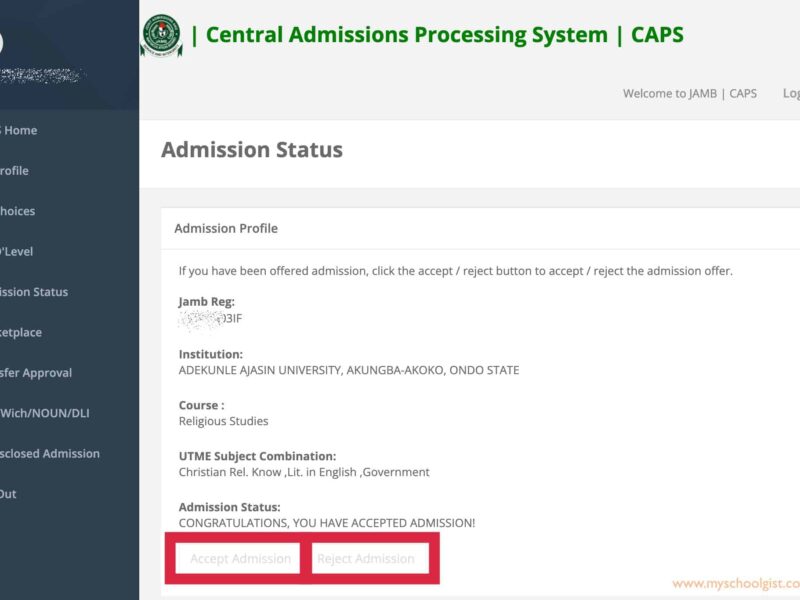
After a few weeks, you’ll start seeing your admission status on JAMB CAPS. If you’re lucky, you’ll get that golden “CONGRATULATIONS, YOU’VE BEEN OFFERED ADMISSION” message.
Once you see it, accept it immediately.
If you don’t, your admission could slip away, especially if you delay too long.
After acceptance, you’ll:
- Pay your acceptance fee,
- Upload all documents again for verification,
- And get ready for clearance and matriculation.
7. Common mistakes LASU applicants make
Let’s be real — most students miss out on LASU admission not because they’re not smart, but because of avoidable errors.
Here are some of the most common ones:
- Using fake or third-party portals for registration.
- Entering wrong O’Level grades or mixing up exam sittings.
- Skipping payment verification after registering.
- Forgetting to print the screening slip.
- Failing to upload O’Level results on JAMB CAPS.
One small slip can make LASU’s system flag your profile as “incomplete.” And when that happens, your name simply won’t appear on the list.
8. How to prepare smartly
- Check your O’Level grades early. Make sure you’ve got all five core subjects before the screening begins.
- Aim for accuracy, not speed. One careful application beats ten rushed ones.
- Keep screenshots of every step. Payment, form submission, printout — everything.
- Monitor LASU’s official channels. The university usually makes announcements on its website and verified social handles.
And yes — avoid “admission agents.” They can’t fast-track what LASU automates.
9. What if you don’t make the cut?
If your aggregate score falls short of your chosen course, don’t lose hope. You still have a few options:
- Apply for a change of course within LASU to a less competitive programme.
- Wait for the supplementary list — LASU often releases multiple batches.
- Or prepare for the next UTME with a sharper strategy.
Remember, plenty of LASU students today didn’t get in on their first try — they just came back smarter.
Final Thoughts
The LASU Post-UTME screening might look like a routine process, but it’s actually the stage where admissions are won or lost.
If you take it seriously, follow instructions carefully, and pay attention to details, you’ll stand out in the crowd — even among thousands of applicants.
Now here’s the real question: if you’re applying to LASU this year, what course are you going for — and how confident are you about your O’Level and JAMB scores holding up in the screening?


 Abdul
Abdul